
The Misconception That’s Costing You Thousands
Walk into any braai in the Western Cape and mention solar, and someone will inevitably say: “It’s too expensive upfront.” That sentiment has kept thousands of South African households and businesses trapped in a cycle of escalating Eskom tariffs and diesel generator dependency — despite the fact that solar photovoltaic (PV) systems now deliver return on investment faster than ever before.
Let’s put the myth to bed with actual numbers, real-world case studies, and current market data from 2024–2025. Because the truth is this: for most families and businesses, not going solar is the expensive choice.
What Does a Residential Solar System Actually Cost in 2025?
According to recent industry reports from the South African Photovoltaic Industry Association (SAPVIA), the average cost of a residential solar PV system has dropped by approximately 60% over the past decade, even as efficiency and warranty periods have improved. For a typical 5 kW system — suitable for a three-bedroom home with standard appliances — you’re looking at an investment between R80,000 and R120,000, depending on battery storage capacity and inverter specifications.
That figure includes installation, COC certification, and SSEG registration where applicable. Yes, it’s a substantial upfront cost. But here’s where the math gets interesting.
Eskom’s tariff increases have averaged 9.61% annually over the past five years, according to data from the National Energy Regulator of South Africa (NERSA). A household paying R2,500 per month today will pay roughly R3,100 per month in just two years if this trend continues. Over a decade, that’s over R450,000 in electricity costs — and that’s before factoring in loadshedding-related losses like spoiled food, lost productivity, and generator fuel.
A properly sized solar system eliminates up to 70% of that expense immediately. For most Western Cape homeowners, payback periods now sit between 4 and 6 years, depending on consumption patterns and available roof space. After that? Every rand you would have sent to Eskom stays in your pocket — or gets invested back into your family’s future.
The Business Case: Faster ROI, Tangible Competitive Advantage
For commercial operations, the numbers are even more compelling. Take a mid-sized manufacturing facility in Paarl that consumes 50,000 kWh monthly. At current Eskom commercial tariffs (averaging R2.20/kWh in 2025), that’s R110,000 per month, or R1.32 million annually.
A 150 kW solar installation with hybrid battery backup typically costs between R2.5 million and R3.5 million. With annual savings of approximately R900,000 (accounting for night-time grid reliance), the payback period is under four years. After that, the business enjoys decades of reduced operating costs — the average commercial-grade solar panel comes with a 25-year performance warranty.
But the ROI extends beyond the electricity bill. A 2024 report from the Green Building Council South Africa noted that businesses with on-site renewable energy see measurable improvements in:
- Operational resilience: No loadshedding downtime means no lost production hours
- Brand reputation: Corporate sustainability credentials matter to consumers and B2B clients alike
- Property valuation: Commercial properties with solar installations command higher sale and lease rates
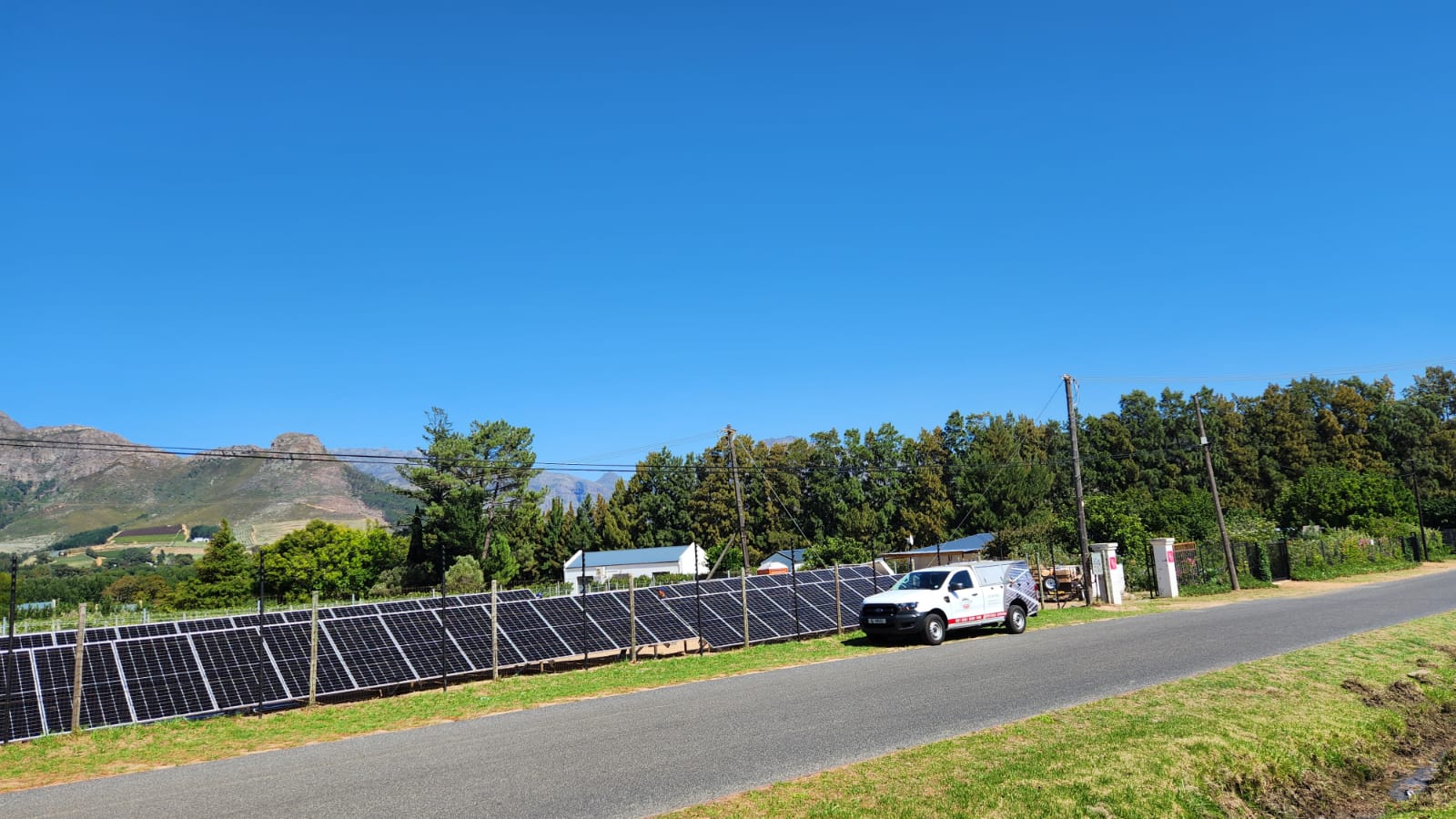
One Stellenbosch winery we worked with reported a 32% reduction in total energy costs within the first year of installation, while simultaneously using their solar credentials in export marketing to European buyers who prioritise sustainability.
What About Off-Grid? The Full Independence Equation
Going completely off-grid is the ultimate energy independence move — and it’s more attainable than most people realise. The key is right-sizing your system and understanding your actual consumption.
A typical off-grid home system (8–10 kW solar array with 20–30 kWh battery storage) costs between R250,000 and R400,000 depending on backup requirements and appliance load. That sounds steep until you consider:
- No monthly electricity bills — ever
- No municipal connection fees (which can exceed R50,000 in some developments)
- No exposure to future tariff hikes or loadshedding schedules
- Increased property value — off-grid-capable homes are commanding premium prices in lifestyle estates
For farms and rural businesses, off-grid solar replaces diesel generators that cost R20–R30 per litre and require constant maintenance. A recent case study from a Swartland grain farm showed diesel costs of R18,000 monthly replaced by a R450,000 solar-plus-battery system — a payback period of just over two years.
The International Energy Agency’s 2024 “Renewables” report highlighted South Africa as one of the fastest-growing solar markets globally, driven largely by off-grid and hybrid installations. We’re not just keeping pace with international trends — we’re leading them out of necessity.
The Hidden Costs of Waiting
Every month you delay is a month of paying for expensive grid electricity while solar technology continues improving and financial incentives remain available. The South African government’s Section 12B tax incentive allows businesses to deduct 125% of renewable energy investment costs in the first year — but policy windows don’t stay open forever.
Meanwhile, load-shedding isn’t going anywhere. Eskom’s own projections suggest ongoing capacity constraints through 2027 at minimum. The question isn’t whether solar makes financial sense — it’s whether you can afford to keep subsidising an unreliable grid.
Your Path to Energy Independence Starts With Real Numbers
At Winelands Solar, we don’t believe in one-size-fits-all solutions or inflated promises. Every system we design starts with a detailed consumption analysis and a transparent ROI projection based on your actual usage patterns and roof configuration.
Our 12 years of experience across residential, commercial, and agricultural installations means we’ve seen every scenario — and we know exactly how to maximise your return while ensuring strict compliance with municipal regulations and SSEG requirements.
Ready to see your real payback timeline? Contact our team for a no-obligation site assessment and customised ROI analysis. Let’s turn that “too expensive” myth into your smartest financial decision of 2026.
Sources
- South African Photovoltaic Industry Association (SAPVIA) — 2024 Industry Report
- National Energy Regulator of South Africa (NERSA) — Historical Tariff Data 2019–2024
- Green Building Council South Africa — “Commercial Solar ROI Study” (2024)
- International Energy Agency — “Renewables 2024: Analysis and Forecasts to 2029”
- Eskom Load Forecasting and Capacity Projections (2024)